The storehouse suites at Nermo: Six years from dream to reality
- Home
- Accommodation
- The Storehouse Suites
The storehouse suites at Nermo – Six years from dream to reality
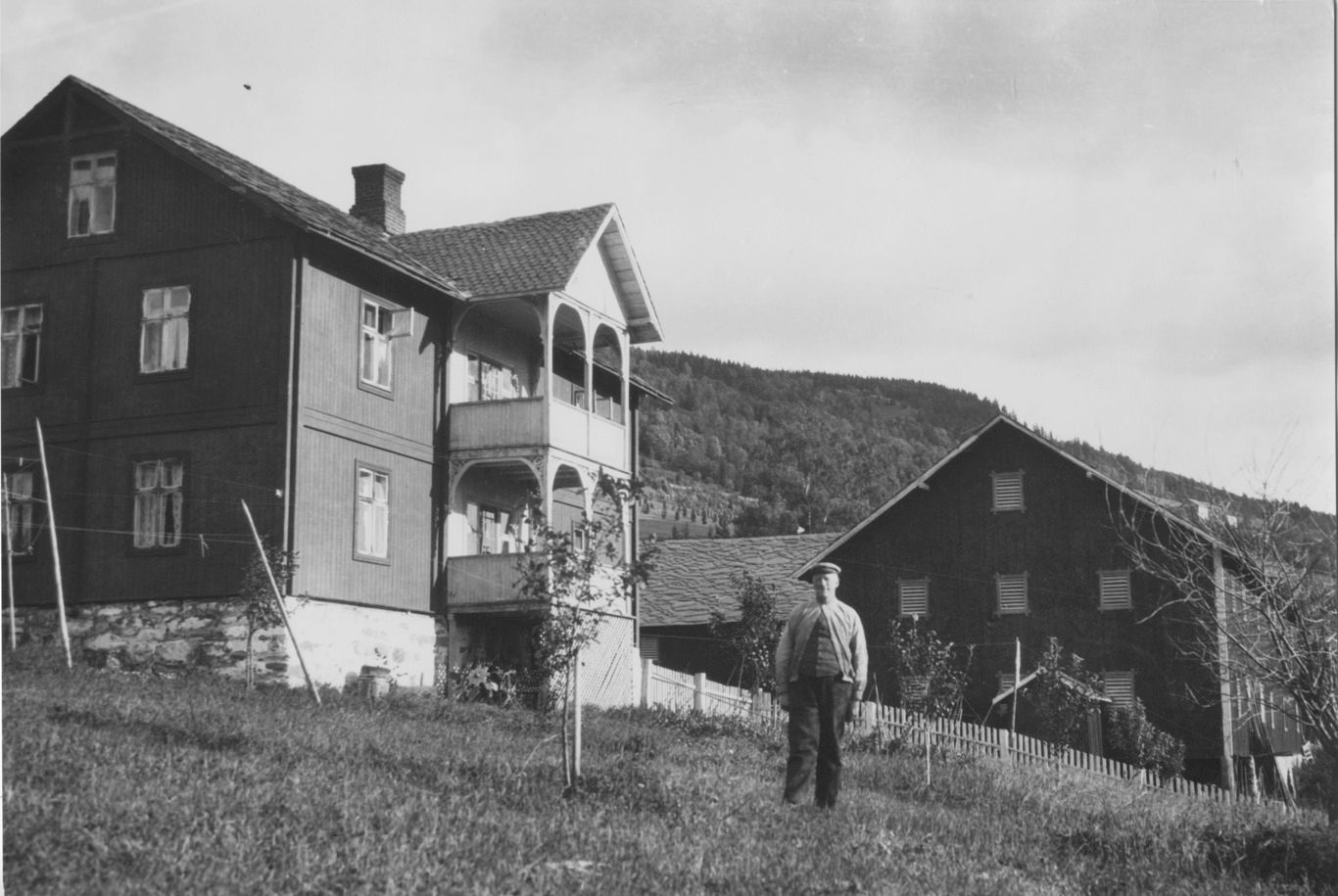
Before the catastrophic fire on Easter Eve 1932, there were four storehouses at Nermo. Two of them were used as guest houses. When the flames reduced everything to ashes, the storehouses also disappeared. But the idea of them lived on.
For over twenty years, Johannes Nermo dreamed of recreating the tradition. Not as a copy of what had once been, but in a form that would unite history with a quiet, modern luxury. It turned out to be a project that took almost six years, involved craftsmen from all over the region, and required everything from 9,600 litres of moss to a good portion of madness.
From Numedal to Gudbrandsdalen
The storehouses were found at Wingestad Farm in Flesberg, Numedal. In 2018, they were carefully dismantled, log by log, and transported to Vangstua Laft at Brøttum, where Jan Erik Fauskrud who was to lead the restoration, was waiting.
The work was extensive. Every single drag, the V-shaped hollow on the underside of the logs, was re-cut. They were filled with moss, picked by hand in the forest. In total, about 160 sixty- litre bags were used. The moss is soaked before it is added to the joints. When it dries, it expands slightly, filling in gaps and retaining its elasticity over time. This is the traditional way to insulate log houses, and remains the best.
For being over 300 years old, there was surprisingly little that needed to be repaired or replaced. The work was carried out with a steady hand and high precision, with respect for both the materials and the history.

The architect and the half-mad hotel owner
As so often before, Arne Thorsrud of RAM Arkitektur was contacted. He has been Nermo's regular architect for a couple of generations. Even after he had retired, Arne made the first sketches.
But it is RAM Arkitektur's Bjartur Lamhauge, originally from the Faro Islands, who should be given the credit for making Johannes' ideas a reality. There is just as much madness in Bjartur as in Johannes. They often met in Bjartur's office early on a Sunday morning, where thoughts, ideas and challenges are discussed, resolved and drafted.
Meho Sortland in Hafjell Bygg was tapped as the builder. He tried his best to sort out Johannes' ideas. When they became excessively grandiose, restoration project lead Jan Erik had to step in and support Meho with his expertise.

Permits and groundwork
The approval came on 1 February 2021. By the 2nd of May, the ring wall had already been cast. Øyer Municipality deserves praise for having been both positive and supportive throughout the process.
The biggest challenges came from the Norwegian Labour Inspection Authority, which initially did not accept that the original doorways should be preserved. It was a long battle, but in the end, the team was successful and the doors remained as they have been for over 300 years.

It is important to concentrate when 126 and 142 logs, respectively, are to be set up in the right order. John Theodor, a sixth generation Nermo, was only 16 years old, but already confident with a chainsaw and well versed in the craft that the family has practiced for generations. Asgeir Brukstuen and Jan Erik Fauskrud worked side by side with him. Olav Sylte Brunvoll, a hard-working young man from Romsdal, handled the tools expertly from the crane. He was also just 16.
On 31 July, the logs had all been placed on the largest storehouse after just 11 days. Both storehouses were erected in a total of 17 days. The work to seal the storehouses took place throughout the late summer and autumn of 2021. Odd Lie, who has worked at Nermo since he was 16 years old and is among the region's foremost masons, laid the foundation with a steady hand.
To be on the safe side, they left both storehouses to set through two winters. This reduced the risk of their settling towards the building between them, which was to have an entire glass wall facing the valley.

Old meets new
The interior design was one of the most demanding aspects of the entire project. It is said that it is everything that is not visible in a building project that costs a fortune. At the storehouses, both plumber and electrician had demanding days, where old had to be connected with new and as little as possible had to be visible.
Originally, a lattice staircase with a landing was planned as the entrance to the suites on the second floor. The idea was rejected and barn bridges were born. Naturally, this was far more demanding to solve.
The bathtubs from Norwegian Wood Design were lowered into the floor on the ground floor. When John had a revelation that the tubs were to be lowered, parts of the ring wall had to be demolished. Plumber Hans Ivar Vangen was called, and it was cast again. Johannes is just under two meters tall, and used himself as a measuring tape when the bathtubs were to be custom-built. The boilers therefore had to be replaced with ones that were twice as big.

The slate roof was laid by Gudbrandsdal Steinindustri, based a quarter of an hour north of Nermo in Aamot, it has extensive professional experience with listed buildings, stave churches and large public buildings. Wardrobes were tailor made to measure. Although they chose a simple design and mouldings, this was some of the most complicated work in the entire project. When old meets new, and everything needs to be as inconspicuous as possible, precision and patience become crucial.
The boss in Hafjell Bygg had perhaps his most nerve-wracking day when the windows were to be put in place. As usual, Meho was well prepared, and luckily everything went exactly as planned.
Impact sound boards were laid on top of the wooden floor, after which an 80 mm concrete floor was cast. The subfloor between the floors consists of three layers of 48x148 mm boards, laid crosswise, attached with glue and screws. The flooring marked a watershed moment. The end of the project was approaching, and the results could finally be envisioned.

Welcome inside
Behind the rough timber walls, you will find rooms that are created for tranquillity. Here, there are no flashing buttons, no gadgets that cry out for attention. The luxury lies in what is felt: in the wood that still smells of history, in the silence, in the warmth that sits in the walls. And yes, in the bathtubs that were perhaps a little bigger than strictly necessary.
Everything is done with respect for what once was, and with care for those who are to come. Old and new are joined together as discreetly as possible, so that the storehouses can be exactly what they are, while at the same time providing the comfort you appreciate after a long day out.
Whether you're coming straight from the mountains, from the ski trail, or just need a place to unwind, we hope this will be a space in which you thrive. A place where the tension melts away. A place in which to stay a little longer than planned.
In February 2025, acknowledgment came from an unexpected source. Historic Hotels Worldwide named the storehouse suites one of the world's 25 most romantic hotels. The following year, they made the list again. News of Johannes' six-year project had spread across the world.
Stay in one of the world’s most romantic rooms – The storehouse suites


